
Santa Barbara County IHSS Wage Crisis: A Call to Action
Click here to see another page of emails, info, and graphs on the data provided
Sorry – This Protest Action is at an end
You’re welcome to use any of this info for your own county wage battles!
Keep up the good fight!
Join Us in Urging the Board of Supervisors to Raise IHSS Caregiver Wages
In February 2025, the Santa Barbara County Board of Supervisors voted themselves a 48.8% raise—boosting their salaries from $115,000 to $171,000 a year. At the same time, the county continues to pay In-Home Supportive Services (IHSS) caregivers just $18.67 an hour. The contrast is staggering: those who care for our most vulnerable are left in poverty while decision-makers enrich themselves.
Real Costs of Care in Santa Barbara County
- Private home care: $27–$34/hr
- Agency-based care: ~$40/hr
- Group homes: $3,900+/month
- 24/7 complex care: $20,000–$25,000/month
- Memory care: $5,600–$10,000+/month
IHSS caregivers save the county millions by keeping people safely at home—yet cannot meet their own basic costs of living.
The Numbers: IHSS & Santa Barbara’s Care Crisis
- 5,484 residents depend on IHSS
- 80–85% of IHSS care is provided at home
- Santa Barbara wage: $18.67/hr
- Living wage benchmark: $23.12/hr
Santa Barbara caregivers face the lowest purchasing power among neighboring counties—even though our cost of living is higher than Ventura, San Luis Obispo, and Los Angeles.
Master Plan for Aging: A Missed Opportunity
On July 15, 2025, the county approved its Master Plan for Aging (2025–2030). Despite 5,000+ residents relying on IHSS, the plan makes no mention of IHSS caregivers. Excluding us from planning undermines the county’s own promises of health equity and access.
Growing Demand, Shrinking Workforce
- By 2030, 1 in 4 residents will be over 60
- Caregiver turnover: 33% annually
- Thousands of IHSS hours go unfilled, pushing people into costly institutions
Why Raising Wages Makes Sense
- Institutional care: ~$120,000/year per person
- IHSS home care: ~$75,000/year per person
- Fair wages stabilize the workforce, improve care, and save taxpayer dollars
What We Are Asking
- Raise IHSS wages to at least $22/hr immediately
- Include IHSS in all future aging plans and budgets
- Recognize and respect the essential work of caregivers
Take Action
Contact your County Supervisor
- Roy Lee (1st District): roylee@countyofsb.org | (805) 568-2186
- Laura Capps (2nd District): lcapps@countyofsb.org | (805) 568-2191
- Joan Hartmann (3rd District): jhartmann@countyofsb.org | (805) 568-2192
- Bob Nelson (4th District): nelson@bos.countyofsb.org | (805) 346-8407
- Steve Lavagnino (5th District): steve.lavagnino@countyofsb.org | (805) 346-8400
Show up at the upcoming wage contract meetings:
- Aug 19, 2025 – 8:00 AM
Santa Barbara County Admin Building, 105 E Anapamu St #406, Santa Barbara, CA 93101 - Aug 26, 2025 – 8:00 AM
511 Lakeside Parkway, Santa Maria, CA 93455
Together, we can demand fairness for those caring for our most vulnerable neighbors.
Press Contacts
- Dan Arel, UDW: darel@udw.org | (619) 252-0397
- Mike Roth: (916) 444-7170
- Mary Bouldin (Author): awesomeluck@gmail.com | (805) 708-9527
Letters emailed to the Santa Barbara County Board of Supervisors
Unacceptable Disparity: Supervisor Salary Hike vs. Stagnant IHSS Wages
I’m writing to you today as an In-Home Supportive Services (IHSS) caregiver and a deeply concerned resident of Santa Barbara County. With our pay contract discussion on the 19th fast approaching, I urge you to consider the stark and frankly, insulting, contrast in recent pay increases between the Board of Supervisors and the essential IHSS caregivers.
In February 2025, this Board approved a 48.8% salary increase for yourselves, boosting your annual pay from approximately $115,000 to $171,000. This substantial raise was justified by comparing your salaries to those in other counties, acknowledging that you were “lagging seriously behind.” And that’s fair – when you’re underpaid, you correct it.
But what about us? IHSS caregivers, who provide critical, often round-the-clock care for our most vulnerable residents, are being offered a proposed raise of just $0.33 on an $18.67 wage. That’s a meager 1.77% increase. To put that in perspective, the Consumer Price Index for the West Region rose 2.7% in the last year (June 2024–June 2025). This means your proposed raise actually puts us 0.93% behind inflation, causing us to lose purchasing power.
This situation is made even more egregious when we compare Santa Barbara County’s IHSS wages to our neighbors, especially given our high cost of living. When you, as Supervisors, were underpaid, you took action to correct it. When IHSS workers are underpaid—significantly so, compared to our peers in surrounding counties, and especially relative to our cost of living—the proposed action only makes our financial struggle worse.
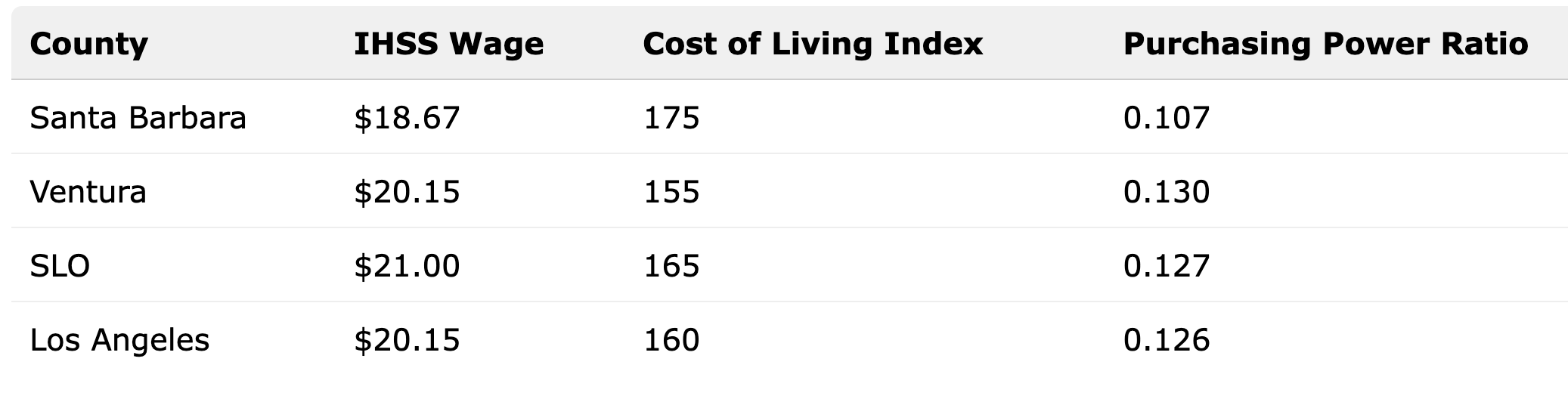
We are asking for fairness and a wage that truly reflects the vital work we do and the real cost of living in Santa Barbara County.

The Unbearable Cost of Living on IHSS Wages in Santa Barbara County
I’m writing to you today to highlight the severe disconnect between the proposed IHSS wage and the actual cost of living in Santa Barbara County. As an IHSS caregiver, I’m deeply concerned about the financial viability of continuing to provide essential care under these conditions.
Our current wage of $18.67 per hour is simply not enough to live on in this region. The MIT Living Wage Calculator estimates that a single adult in Santa Barbara County (with no children) needs approximately $32.10 per hour ($66,793/year) to meet basic living expenses. Furthermore, a new state report defines the low-income threshold for a single adult in Santa Barbara County as about $98,850 per year.
This means that even if an IHSS caregiver works full-time, they earn barely enough to survive, falling squarely into the “very low income” category. The proposed $0.33 increase to $19.00 per hour does little to close this gap; in fact, it represents a loss in purchasing power due to inflation.
How can we be expected to provide compassionate, consistent care when we’re struggling to afford rent, food, and basic necessities in the very community we serve? Our financial stability directly impacts our ability to remain in this critical role.
I urge you to consider these real-world economic pressures when discussing our pay contract on the 19th. Providing a living wage for IHSS caregivers is not just an act of fairness; it’s an investment in the stability of our care system and the well-being of our community.

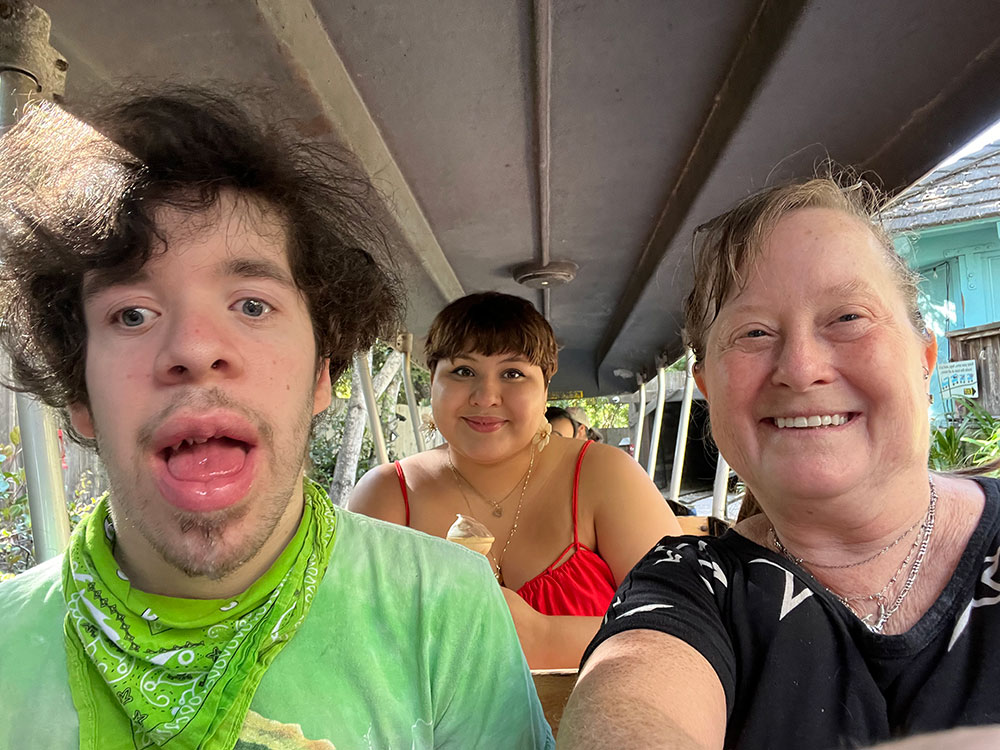
Beyond the Numbers: My Son's Complex Needs and the Reality of IHSS Care
I’m writing to you today not just as an IHSS caregiver, but as a parent providing constant, dedicated care for my son here in Santa Barbara County. I want to share a glimpse into what caregiving truly looks like, as it is often misunderstood and profoundly undervalued.
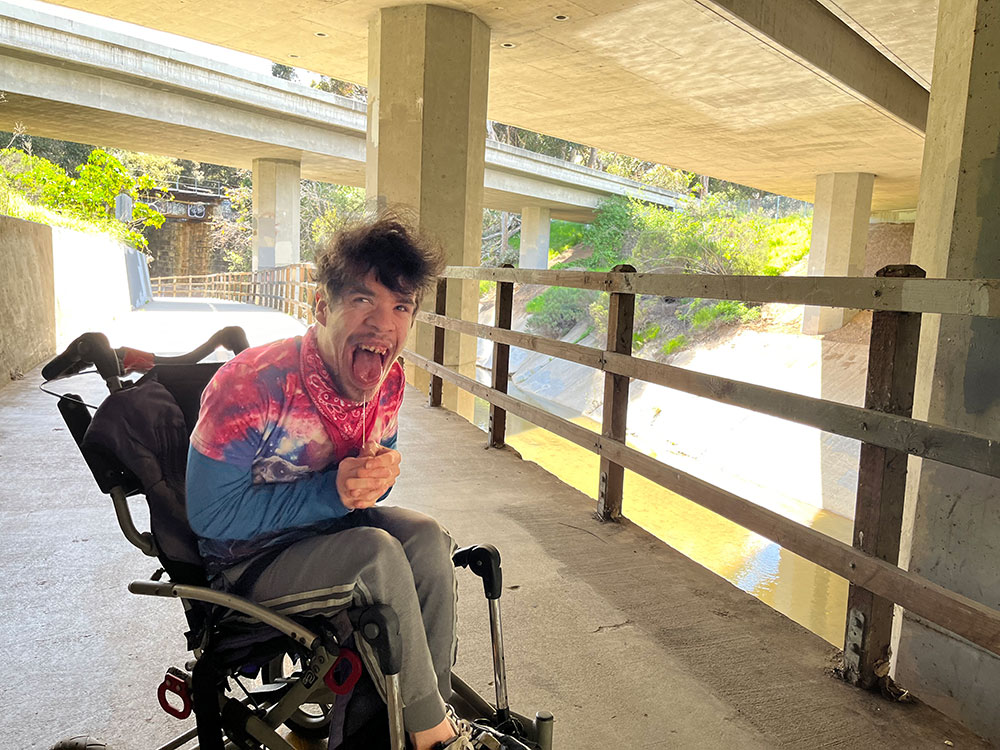
My son has Coffin-Siris Syndrome, a rare condition with a likelihood of 1 in 100,000, meaning there are no local specialists or community support to lean on. His complex needs include seizures, Crohn’s disease, non-verbal autism, and severe developmental delay. He has no sense of depth or understanding of self-preservation or danger, leading to a constant elopement risk that requires vigilant, around-the-clock monitoring.
At 24 years old, he still wears diapers, doesn’t chew effectively, and requires a pureed diet. Most profoundly, he hasn’t slept through the night in 24 years, necessitating continuous, active monitoring throughout every single night. This is not casual or companion care; it is skilled, intensive, and often physically demanding labor that is required 24 hours a day, 7 days a week.
While I am paid for approximately 70 hours of work per week, the reality is that I work a total of 140 hours or more. This massive disparity means countless hours of essential, skilled labor go uncompensated. Many other caregivers in Santa Barbara County also deal with complex family members who require extensive hours beyond their paid allocation. This vital, round-the-clock commitment is what keeps our loved ones safely at home and out of more costly institutional settings, saving the county and state significant money.
Yet, despite this profound dedication and the critical nature of the care I provide, the current IHSS wage of $18.67 per hour forces me, and many other dedicated caregivers, into a constant struggle to make ends meet.
I urge you to see beyond the statistics and recognize the profound human effort, love, and sacrifice that goes into this work. Our commitment to our loved ones is unwavering, and we ask for a wage that allows us to live with dignity in the community we serve.
The Unseen Labor: Why IHSS Caregivers Cannot Be Self-Supporting
Following my previous message about the realities of IHSS care, I want to bring your attention to a critical, yet often overlooked, aspect of our work: the vast number of “hidden hours” that go unpaid. While the IHSS program allocates a specific number of paid hours, the actual time and dedication required to provide comprehensive care for individuals like my son far exceeds this.
As I mentioned, I am paid for approximately 70 hours of work per week, but the reality is that I work a total of 140 hours or more. This massive disparity means countless hours of essential, skilled labor go uncompensated. Because my caregiving responsibilities are truly around-the-clock, it’s impossible for me to take on another job to supplement my income. Many other caregivers across Santa Barbara County face the same challenge, dealing with complex family members who require extensive hours beyond their paid allocation, leaving no room for other employment.
This combination of poor hourly wages and the inability to work more hours makes it impossible for us to be self-supporting. It feels as though the system relies on the profound dedication and love we have for our family members, expecting us to stay no matter how low the wage. This is a system that takes advantage of our commitment, pushing us to the brink. As inflation continues to increase, we are being forced to consider options we have worked so hard to avoid, jeopardizing the very care our loved ones depend on.
Ignoring this reality not only exploits caregivers but also undermines the stability of the entire IHSS program, as dedicated individuals are forced to leave due to financial strain, despite their deep desire to continue caring for their family members.
We urge you to acknowledge the full scope of the work IHSS caregivers provide and ensure our compensation truly reflects a living wage that allows us to live with dignity in the community we serve.

The Long-Term Cost of Caregiving: Financial Penalties for IHSS Providers
Today, I want to address a critical, often overlooked consequence of being an IHSS caregiver: the significant long-term financial penalties we incur by choosing to provide essential in-home care. While our work saves the county immense sums, it simultaneously jeopardizes our own financial futures.
For most in-home caregivers, we are allowed to opt for a tax-exempt status on our income. This is presented as a way to qualify for Medi-Cal, which for many of us, is our only affordable access to healthcare, given our significantly low wages. While California does offer other healthcare options, purchasing into them would mean less money for rent, less money for food, and less money for other basic necessities.
This isn’t a genuine choice; it’s a devastating trade-off. By not having taxable income, we are not paying into Social Security, leaving us with no retirement benefits from this demanding labor. Despite working 70 hours a week, which should typically qualify someone for health insurance, the state effectively avoids this cost through this very strategy. We are caught in an impossible bind: if we were to start paying taxes to build Social Security, we would immediately lose our Medi-Cal eligibility and be forced to purchase expensive private health insurance, further eroding our already meager income. There is no viable alternative to this path. We are gambling that the minimal money we must have to survive now will not compromise our future.
This system, which relies on our dedication, effectively penalizes us for providing the most compassionate and cost-effective care possible, pushing us towards poverty in our own later years. It feels as though our profound love and commitment to our family members are being taken advantage of, expecting us to stay no matter the personal cost.
We urge you to consider these long-term financial consequences. Investing in a living wage for IHSS caregivers is not just about immediate relief; it’s about ensuring a dignified and secure future for those who dedicate their lives to caring for our most vulnerable.
A Glaring Omission: IHSS Exclusion from Santa Barbara's Master Plan for Aging
I’m writing to you today with profound concern regarding a significant oversight in the recently approved Santa Barbara County Master Plan for Aging 2025–2030. While this plan aims to be a comprehensive roadmap for supporting older adults, people with disabilities, and caregivers, it inexplicably excludes the In-Home Supportive Services (IHSS) program.
This exclusion is not just an administrative error; it’s a critical misstep that ignores the reality for thousands of our most vulnerable residents. There are 5,484 residents in Santa Barbara County who rely on IHSS for their daily care, enabling them to live with health, safety, and dignity in their own homes. These individuals, and the caregivers who serve them, are precisely who this plan is meant to support.
Furthermore, IHSS is consistently the most cost-effective public care solution in the county, saving millions of dollars annually by preventing more expensive institutionalization. Ignoring a program that serves such a large, vulnerable population and provides such significant financial benefit fundamentally undermines the very goals of health equity, care access, and financial responsibility that the Master Plan claims to address.
How can a comprehensive plan for aging and disability effectively serve our community when it fails to even mention the program that provides the majority of in-home care? This omission sends a message that IHSS providers and clients are not a priority.
I urge you to rectify this oversight immediately. IHSS must be explicitly included in future strategic plans, funding priorities, and all discussions related to aging and disability services in Santa Barbara County.

Impending Crisis: Growing Demand Meets Shrinking IHSS Workforce
Today, I want to draw your urgent attention to a looming crisis in Santa Barbara County’s care system: the growing demand for in-home care is rapidly outpacing a shrinking caregiver workforce. Without immediate action on wages, this imbalance threatens to collapse the very support system our most vulnerable residents rely on.
The demographic trends are clear and undeniable. By 2030, one in four Santa Barbara County residents will be over 60. Looking further ahead, by 2060, our 65+ population is projected to double. This means the need for IHSS caregivers will only intensify dramatically.
Yet, despite this escalating demand, our caregiver workforce is shrinking at an alarming rate. A staggering 33% of IHSS caregivers leave the program annually. This high turnover means that thousands of authorized care hours across the county go unfilled, leaving vulnerable individuals without the essential support they need.
The reason for this exodus is simple and directly tied to our compensation. Low wages push dedicated caregivers into poverty, forcing them to quit or take second jobs just to survive. As I’ve highlighted in previous emails, the current $18.67/hour wage is not a living wage in Santa Barbara County, and the proposed increase doesn’t even keep pace with inflation.
My story is one of thousands. Santa Barbara County will inevitably lose caregivers like me, who are committed to providing essential care, if our wages do not reflect the true cost of living and the critical nature of our work. This isn’t just about fairness; it’s about preventing a profound care crisis that will impact countless families and strain county resources.
We urge you to recognize this critical demographic and workforce challenge and take decisive action to raise IHSS wages to stabilize our vital care infrastructure.

A Smart Investment: How Raising IHSS Wages Saves Santa Barbara County Millions
Today, I want to present a compelling financial argument for raising IHSS caregiver wages: it is not an expense, but a strategic investment that will save Santa Barbara County millions of dollars annually. Our work directly prevents far more costly institutionalization, making IHSS the most fiscally responsible care solution available.
Consider the stark financial reality:
- Institutional care for one individual averages approximately $120,000 per year.
- Home care via IHSS, on the other hand, costs around $75,000 per year.
This means that for every resident who can remain in their home through IHSS, the county and state save an estimated $45,000 annually.
With 5,484 residents currently relying on IHSS, and 80-85% of that care provided in the home, the collective savings are immense. If just 100 residents avoid institutionalization each year due to the availability of stable, quality IHSS care, that translates to $4.5 million saved annually for the county.
Investing in a living wage for IHSS caregivers directly supports this cost-effective model. Higher wages lead to lower caregiver turnover, ensuring more consistent and reliable care. When caregivers are more stable and less burdened by financial stress, they can provide better, uninterrupted care, which in turn reduces the likelihood of health crises that could force clients into expensive emergency room visits or long-term institutional care.
Raising IHSS wages is a clear win-win: it provides dignity and greater stability for essential caregivers, and it safeguards the county’s budget by sustaining the most economical care option for our vulnerable population.
IHSS Caregivers: The Unsung Infrastructure of Santa Barbara County
Today, I want to ask you to consider In-Home Supportive Services (IHSS) caregivers in a new light: as essential infrastructure for Santa Barbara County. Just like our roads, schools, and emergency services, the care we provide is a fundamental pillar that supports our community’s health, stability, and well-being.
When we talk about infrastructure, we often think of physical structures. However, the human infrastructure that enables our most vulnerable residents to live safely and with dignity at home is equally, if not more, critical. We are the frontline workers who ensure that thousands of elderly, disabled, and medically fragile individuals receive the daily support they need.
Our work directly:
- Prevents system collapse: Without IHSS, countless individuals would be forced into institutional care, overwhelming our healthcare facilities and county budget.
- Supports public health: By providing consistent, personalized care, we reduce ER visits, prevent hospitalizations, and manage chronic conditions, alleviating strain on the broader healthcare system.
- Contributes to economic stability (with a critical caveat): For some families, IHSS enables other family members to remain in the broader workforce. However, for many primary caregivers like myself, the round-the-clock nature of our IHSS work prevents outside employment, making fair wages for our direct care even more critical.
Yet, despite this vital role, IHSS caregivers are paid wages that force us into poverty, leading to high turnover and a shrinking workforce. This is akin to neglecting our bridges until they crumble, or underfunding our schools until they fail. A strong community requires strong infrastructure, and that includes a stable, fairly compensated caregiving workforce.
Investing in IHSS wages is not merely a social program; it is an investment in the foundational infrastructure of Santa Barbara County. It’s about recognizing our work as critical to the fabric of our society.
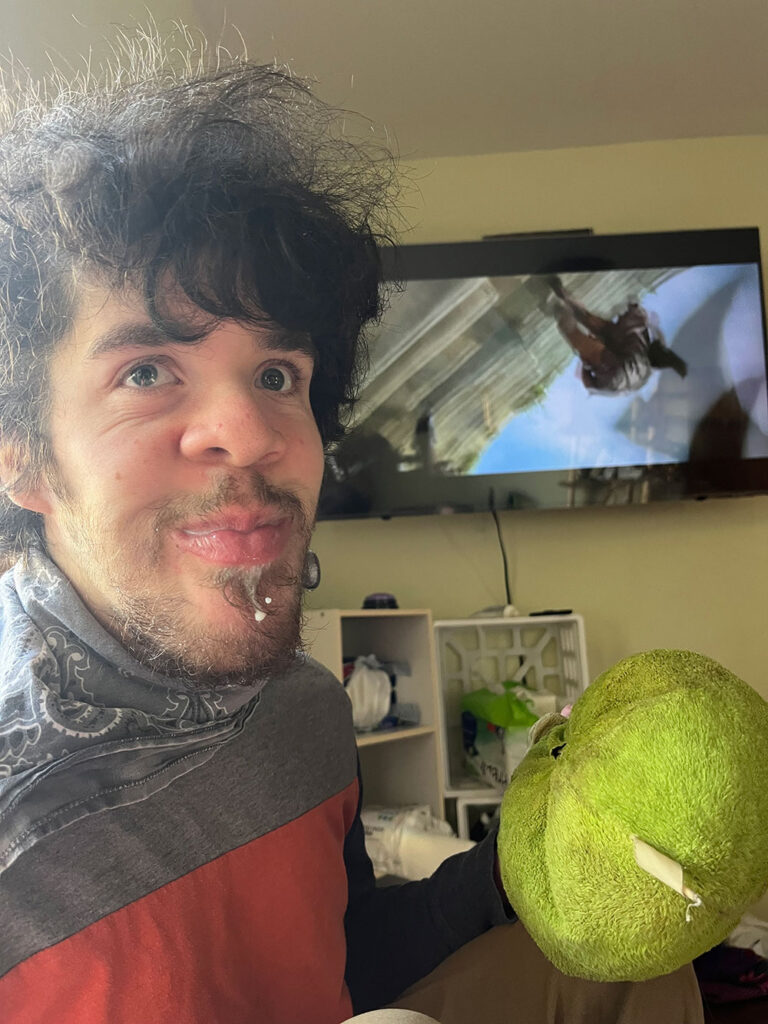
Demanding Transparency: Public Accountability for Santa Barbara County Funds
Today, I’m writing to you to underscore the critical importance of public accountability in how Santa Barbara County prioritizes and allocates its funds, particularly concerning the In-Home Supportive Services (IHSS) program. As a taxpayer and an essential caregiver, I believe the community deserves clear transparency on these financial decisions.
We’ve seen the Board of Supervisors approve a substantial 48.8% salary increase for yourselves, citing the need to catch up to market rates. Yet, when it comes to IHSS caregivers, who provide indispensable services that save the county millions annually by preventing institutionalization, we are offered a raise that doesn’t even keep pace with inflation.
This stark contrast raises serious questions about the county’s priorities. How are public funds being allocated, and what metrics are truly guiding these decisions? When the county benefits immensely from the cost-effective care provided by IHSS, yet proposes wages that force caregivers into poverty and threaten the stability of the program, it demands a clear explanation.
The residents of Santa Barbara County, especially those who rely on IHSS and their dedicated caregivers, deserve to understand how their tax dollars are being used and why essential services like ours are being systematically undervalued. We are asking for more than just a wage increase; we are asking for a commitment to fairness, equity, and responsible financial stewardship.
I urge you to demonstrate true public accountability by prioritizing a living wage for IHSS caregivers and ensuring that the allocation of county funds reflects the genuine needs and contributions of all its residents.

A Moral Imperative: Supporting IHSS Caregivers is a Matter of Community Ethics
Today, I want to appeal to our shared sense of community and moral responsibility. Beyond the economic arguments and logistical challenges, supporting In-Home Supportive Services (IHSS) caregivers with a living wage is fundamentally a moral obligation and a reflection of our county’s core ethics.
We, as IHSS caregivers, provide care for Santa Barbara County’s most vulnerable residents—our elderly, our disabled, and those with complex medical needs. This work is not merely a job; it is an act of profound dedication, often driven by love for family members, and it allows these individuals to live with dignity and safety in their own homes.
The current wage of $18.67 per hour, and the proposed increase of only $0.33, which falls behind inflation and forces caregivers into financial precarity, sends a deeply troubling message. It suggests that the immense value of this work, and the well-being of those who perform it, are not truly prioritized. How can we, as a compassionate community, allow the very individuals who provide such essential, intimate care to struggle to afford basic necessities in the county they serve?
Fairness dictates that those who contribute so significantly to the public good should be able to live with dignity. Our work prevents suffering, saves public funds, and upholds the values of a caring society. To deny IHSS caregivers a living wage is to undermine these very principles.
I urge you to consider the moral weight of this decision. Prioritizing a fair wage for IHSS caregivers is an opportunity to affirm our community’s commitment to justice, compassion, and the fundamental right to live free from poverty, especially for those who dedicate their lives to caring for others.

The Hidden Cost: IHSS Caregivers' Health and Safety at Risk
Today, I want to bring to your attention a critical aspect of IHSS care that is often overlooked: the profound toll it takes on the health and safety of caregivers themselves. Our dedication to our loved ones comes at a significant personal cost, one that is exacerbated by inadequate wages and the relentless demands of the job.
The nature of IHSS work involves constant physical and emotional strain. We are frequently engaged in tasks that lead to physical injuries, from lifting and transferring individuals with mobility challenges to managing complex medical needs. For caregivers like myself, who provide around-the-clock supervision for someone who hasn’t slept through the night in decades, the lack of rest is a chronic and debilitating issue.
This isn’t just about feeling tired; it’s about the long-term risks to our own well-being. Chronic sleep deprivation, physical exertion, and the immense stress of being constantly “on call” contribute to serious health problems over time. We are sacrificing our own health and future to provide essential care, often without the means to access adequate healthcare or build a financial safety net for ourselves.
It’s a cruel irony that those who prevent institutionalization and save the county millions are pushed to the brink of their own physical and mental endurance, with little recognition or compensation for this sacrifice. Our ability to continue providing compassionate, high-quality care is directly tied to our own capacity to remain healthy and resilient.
I urge you to consider the human cost of these conditions. Investing in a living wage for IHSS caregivers is not just about financial fairness; it’s about protecting the health and safety of the very individuals who serve as the backbone of our community’s care system.
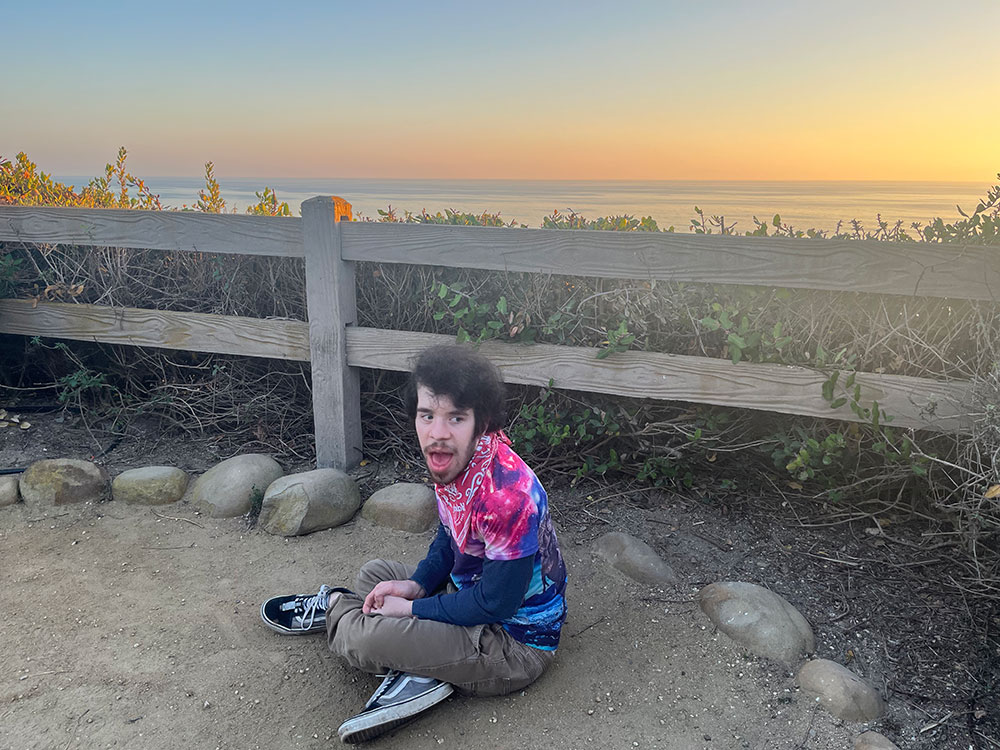
Beyond Assumptions: The Professional Background and Dedication of IHSS Caregivers
I am writing to you today as Mary Bouldin, an In-Home Supportive Services (IHSS) caregiver in Santa Barbara County. I want to address a critical misconception: the assumption that IHSS caregivers are uneducated or lack professional skills. This is a profound misjudgment of a highly capable and dedicated workforce.
Many IHSS caregivers, myself included, bring significant professional experience and education to this demanding role. Before becoming an IHSS employee, I earned a college degree and worked in a profitable career as a graphic designer. For me, this was not a step up, but a conscious, albeit crushing, choice to prioritize my son’s well-being. I gave up my career and life plans because it was the right decision for my family, not because I lacked other options.
My son, Tom, has Coffin-Siris Syndrome, and his needs are extensive and relentless. He experiences seizures and other complex health issues, requiring frequent doctor’s visits, specialized anesthesia dentistry, management of his VNS (Vagus Nerve Stimulator), and regular bloodwork. He still requires diaper changes, doesn’t chew effectively, needs a pureed diet, and most critically, hasn’t slept through the night in 24 years, requiring around-the-clock monitoring.
I am a single parent, and I have nobody else to help me. I am the sole provider of care for this young man, 24 hours a day, 7 days a week. This level of care demands immense skill, patience, and unwavering commitment.
The current IHSS wage of $18.67 per hour, with a proposed $0.33 increase, simply does not reflect the immense responsibility, the skilled labor, or the professional capabilities that many of us bring to this role. It exploits our dedication and love for our family members, pushing us into financial precarity despite the critical public service we provide. This wage perpetuates the false narrative that our work is unskilled, when in reality, it is complex, demanding, and invaluable.
I urge you to look beyond assumptions and recognize the true caliber of the IHSS workforce. Our collective commitment keeps our most vulnerable residents safely at home and saves the county millions. It is time for our compensation to reflect the true value of this essential, life-sustaining work, acknowledging the professionalism and dedication of every caregiver.

The Undervalued Scope of My Son's Care
I am writing to you as Mary Bouldin, an IHSS caregiver for my son, Tom. While I am grateful for the 10 hours of paid care per day, I must bring to your attention that the nature of my work extends far beyond the basic home care tasks for which I am compensated. This is not a job where I can simply “sit around and watch soap operas”; it is a complex, demanding, and highly skilled role for which the responsibilities never end. The current compensation structure fails to account for this reality.
The 10 hours a day I am approved for include a significant amount of uncompensated administrative, logistical, and advocacy work that is essential to keeping my son healthy and safe. It is this work—the work of a case manager—that the county is currently receiving for a rate intended for other tasks.
For example, my son, Tom, takes nine different medications, which requires constant vigilance and proactive planning. I have to manage three different CVS pharmacies to acquire all of his essential medicines. When there are communication breakdowns between doctors and pharmacists, I have, on multiple occasions, had to drive to Oxnard or Santa Maria to secure an emergency refill—a significant, unpaid time commitment.
The logistical coordination for his health is a full-time job in itself. My son has four doctors: a GP, a gastroenterologist, a neurologist, and an anesthesia dentist. I am responsible for scheduling, preparing for, and transporting him to all of these appointments, in addition to regular bloodwork and immunizations.
Furthermore, I have to act as a supply chain manager for his basic needs. Tom has specific dietary restrictions—no dairy or gluten—and because he cannot chew, a great deal of my time is spent preparing his food. I also source the soybeans for his special soymilk from a national company that delivers them to a local storage unit, which I then have to collect myself. This is a complex logistical task that requires significant time and effort.
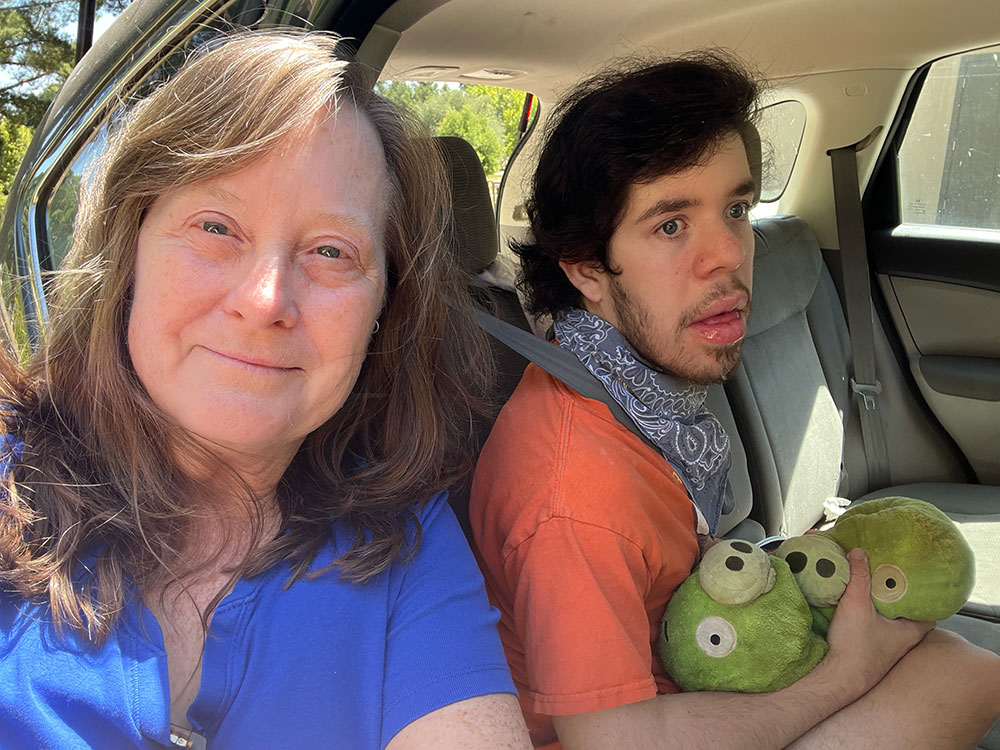
To add to this, we were recently given a new wheelchair for Tom that is finally large enough for him. However, the chair is too big for my car. To get it in, I have to put down one of the back seats, open the back hatch, and open a side door to move it into place. This is a heavy, bulky, and difficult three-part process that puts a tremendous physical strain on me every time we have to leave the house. A newer, used car that could accommodate the chair would solve this problem, but my current income simply does not make that possible.
This work is relentless and requires unwavering dedication, especially when I am sick. When my son and I both had COVID, I was still on the clock. While every other family member was incapacitated, I was responsible for Tom’s diapers, feeding, and medications. This is not a job for the weak; I perform these duties while often sleeping only 3 to 5 hours a night, all while maintaining a kind and loving parental presence.
We are not just hands-on care providers; we are scheduling coordinators, medication managers, supply chain specialists, and tireless advocates. The 10 hours a day I am compensated for require expertise that far exceeds the current pay rate. I urge you to consider the full scope of our responsibilities and reevaluate the compensation structure to reflect the true value of all that we do.

The Hidden Public Health Crisis of Caregiving
I am writing to you today to shed light on a crucial, and often overlooked, aspect of my role as an IHSS caregiver for my son, Tom: the significant mental and emotional toll of the work. While the approved 10 hours a day are meant to cover basic physical care, they completely fail to account for the psychological burden of a role that demands constant vigilance and advocacy. This is not just a personal struggle; it is a well-documented public health crisis with a direct impact on the quality of care provided.
A substantial body of research shows that family members who provide care for individuals with chronic or disabling conditions are themselves at risk. The psychological health of a caregiver is negatively affected by providing care, with studies consistently reporting higher levels of stress, anxiety, and depression among caregivers. Between 40-70% of caregivers have clinically significant symptoms of depression, with a large portion of those meeting the criteria for major depression.
From my own experience, this is not a coincidence. The relentless pressure of managing my son’s nine medications, coordinating with four different doctors, and constantly being on high alert to his needs has contributed directly to my own struggles with complex PTSD and anxiety. Caregivers are often referred to as “hidden casualties,” and I am evidence of that. The medical literature points to events like witnessing a loved one’s health decline as trauma-inducing, which can lead to conditions like Acute Stress Disorder and Post Traumatic Stress Disorder (PTSD). My daily life, characterized by a state of constant readiness and the stress of managing a complex care regimen, is a textbook example of this.
This psychological burden is compounded by a profound sense of “ambiguous loss”—the grief that comes from caring for someone who is both here and gone. This is a common experience for family caregivers and can lead to complicated grief disorders.
The mental and emotional strain is not just an inconvenience; it has direct physical consequences. Caregivers show diminished immune responses, increased stress hormones, and a higher risk of serious illnesses like heart disease. The lack of support and the low compensation force me to endure these health risks, all while being responsible for my son’s well-being.
The current system acknowledges the physical work of caregiving, but it fails to recognize the mental and emotional labor that underpins it. This is a public health issue that should be a priority. Keeping family caregivers healthy and able to provide care is key to maintaining our long-term care system and keeping people out of institutions. The health of the caregiver is the single most important factor in a family’s ability to provide sustained, in-home care.
I urge you to consider this information and acknowledge the full scope of our work. Caregiving requires a healthy mind as much as a healthy body, and the current compensation structure fails to support either.

Emails Specific to Individual County Supervisors
Supervisor Capps
I am writing to you today as Mary Bouldin, an In-Home Supportive Services (IHSS) caregiver and a deeply concerned resident of Santa Barbara County. Following the recent discussion regarding our pay contract, and in advance of the upcoming Santa Maria meeting, I urge you to apply your “results-oriented” approach to the critical situation faced by IHSS caregivers.
You’ve consistently stated, “I want people to know that we at the Board of Supervisors understand how hard it is to live here,” and that your role is to “help make people’s lives better, as best I can.” Your focus on affordable housing, especially workforce housing, and your commitment to making “government work for people” by prioritizing results over rigid processes, resonate deeply with the challenges IHSS caregivers face daily. You’ve also emphasized that your work will “center on the children of our county and their future.”
As an IHSS caregiver, I embody the very workforce you aim to support. I provide 24/7, complex care for my son, who has Coffin-Siris Syndrome, seizures, non-verbal autism, and requires constant monitoring. While I work 140 hours or more per week, I am compensated for only 70. Given that I work 140 hours or more per week, it is impossible for me to earn income elsewhere. This makes it impossible to be self-supporting or build a secure financial future. For most in-home caregivers, our tax-exempt income, while allowing us to qualify for Medi-Cal (our only affordable option for healthcare given our low wages), means we are not paying into Social Security, creating a devastating long-term financial trap.
The county’s proposed $0.33 raise on our $18.67 wage not only falls behind inflation but actively undermines your stated goals. It makes it harder, not easier, for essential workers like me to afford to live here. It creates a system where the very people caring for the county’s most vulnerable children and adults are pushed into financial precarity, which is certainly not the “result” we need for our community’s future.
Supervisor Capps, your commitment to addressing the high cost of living and ensuring government delivers tangible results is precisely what is needed now. We are asking for a wage that truly reflects the vital work we do and allows caregivers to live with dignity in Santa Barbara County, ensuring stability for both our workforce and the vulnerable individuals we serve.
We urge you to champion a living wage for IHSS providers, turning your stated commitment into concrete results for those who provide essential care.
Supervisor Hartmann
I am writing to you today as Mary Bouldin, an In-Home Supportive Services (IHSS) caregiver and a deeply concerned resident of Santa Barbara County. Following the recent discussion regarding our pay contract, and in advance of the upcoming Santa Maria meeting, I urge you to consider the critical situation faced by IHSS caregivers through the lens of your unwavering dedication to our community’s most vulnerable.
You’ve consistently demonstrated your commitment to the welfare of our citizens, particularly through your work chairing both the KIDS and Adult and Aging Networks. Your compassion extends to “our most vulnerable citizens as well,” and you strive to “maintain the quality of life we enjoy here in the Santa Barbara County for our children and all future generations.” You’ve been described as someone who “totally gets it” when it comes to the complex challenges facing our community.
As an IHSS caregiver, I represent the backbone of the care infrastructure for many of these vulnerable residents—including children and seniors. I provide 24/7, complex care for my son, who has Coffin-Siris Syndrome, seizures, non-verbal autism, and requires constant monitoring. While I work 140 hours or more per week, I am compensated for only 70. Given that I work 140 hours or more per week, it is impossible for me to earn income elsewhere. This makes it impossible to be self-supporting or build a secure financial future. For most in-home caregivers, our tax-exempt income, while allowing us to qualify for Medi-Cal (our only affordable option for healthcare given our low wages), means we are not paying into Social Security, creating a devastating long-term financial trap.
The county’s proposed $0.33 raise on our $18.67 wage not only falls behind inflation but fundamentally undermines your stated dedication to the welfare of children and seniors. It exacerbates the financial struggle for caregivers who save the county millions by preventing far more expensive institutional care. This is not how we maintain or improve the quality of life for those who depend on us most.
Supervisor Hartmann, your leadership in advocating for children, seniors, and addressing critical community needs is precisely what is required now. We are asking for fairness and a wage that truly reflects the vital work we do and the real cost of living in Santa Barbara County, allowing caregivers to achieve a dignified life and continue serving our most vulnerable.
We urge you to champion a living wage for IHSS providers, ensuring that your commitment to our most vulnerable citizens is fully realized in their daily lives.
Supervisor Lavagnino
I am writing to you today as Mary Bouldin, an In-Home Supportive Services (IHSS) caregiver and a deeply concerned resident of Santa Barbara County. Following the recent discussion regarding our pay contract, and in advance of the upcoming Santa Maria meeting, I urge you to consider the critical situation faced by IHSS caregivers through the lens of your commitment to “leave them better than when I got here.”
You’ve consistently expressed a desire to improve conditions, whether it’s addressing homelessness, mental health, or other community challenges. You’ve recognized that investing in solutions for complex issues, such as mental health services, can “actually save us money” from a “hawkish budget eye” perspective. Your focus on listening to community members and efficiently addressing their concerns is also deeply appreciated.
As an IHSS caregiver, I represent a vital part of the solution for our county’s most vulnerable residents. I provide 24/7, complex care for my son, who has Coffin-Siris Syndrome, seizures, non-verbal autism, and requires constant monitoring. While I work 140 hours or more per week, I am compensated for only 70. Given that I work 140 hours or more per week, it is impossible for me to earn income elsewhere. This makes it impossible to be self-supporting or build a secure financial future. For most in-home caregivers, our tax-exempt income, while allowing us to qualify for Medi-Cal (our only affordable option for healthcare given our low wages), means we are not paying into Social Security, creating a devastating long-term financial trap.
The county’s proposed $0.33 raise on our $18.67 wage not only falls behind inflation but actively undermines the stability of the IHSS program. This is not “leaving things better” for the essential workforce that prevents far more expensive institutional care, saving the county millions annually. Instead, it forces dedicated individuals into poverty, leading to turnover and a less effective care system, which ultimately costs the county more in the long run.
Supervisor Lavagnino, your pragmatic approach to solving complex problems and your desire to improve conditions for our community are precisely what is needed now. We are asking for a wage that truly reflects the vital work we do and the real cost of living in Santa Barbara County, allowing caregivers to achieve a dignified life and contribute fully to a stronger, more stable care system.
We urge you to champion a living wage for IHSS providers, aligning county policy with your stated goal of leaving our community better than you found it.
Supervisor Lee
I am writing to you today as Mary Bouldin, an In-Home Supportive Services (IHSS) caregiver and a deeply concerned resident of Santa Barbara County. Following the recent discussion regarding our pay contract, and in advance of the upcoming Santa Maria meeting, I urge you to consider the critical situation faced by IHSS caregivers through the lens of the values you so powerfully articulate.
You’ve spoken about your belief that “Anybody that wants to make a better life for themselves and work hard in this country, I fully support that,” and your commitment to “Leadership That Listens and Serves the People, Not Special Interests,” and to fostering a government that is “open, ethical, and dedicated to serving its residents first and foremost.” These are universal principles that resonate deeply with all who dedicate themselves to their community.
As an IHSS caregiver, I embody this dedication to hard work and serving our community. I provide 24/7, complex care for my son, who has Coffin-Siris Syndrome, seizures, non-verbal autism, and requires constant monitoring. While I work 140 hours or more per week, I am compensated for only 70. Given that I work 140 hours or more per week, it is impossible for me to earn income elsewhere. This makes it impossible to be self-supporting or build a secure financial future.
To be specific about our financial future: for most in-home caregivers, our tax-exempt income, while allowing us to qualify for Medi-Cal (our only affordable healthcare option given our low wages), means we are not paying into Social Security. This creates a devastating long-term financial trap, leaving us with no retirement benefits from this demanding labor. This system relies on our profound dedication, pushing us to the brink.
The county’s proposed $0.33 raise on our $18.67 wage not only falls behind inflation but fundamentally contradicts the ideal of making a better life through hard work for all residents. It exacerbates the financial struggle for caregivers who save the county millions by preventing far more expensive institutional care. This is not a system that is genuinely listening to or serving its essential workers first and foremost.
Supervisor Lee, your commitment to public interest and accountable leadership is precisely what is needed now. We are asking for fairness and a wage that truly reflects the vital work we do and the real cost of living in Santa Barbara County, allowing caregivers to achieve a dignified life and continue serving our most vulnerable.
We urge you to champion a living wage for IHSS providers, upholding the values of hard work and community service you so deeply believe in.
Supervisor Nelson
I am writing to you today as Mary Bouldin, an In-Home Supportive Services (IHSS) caregiver and a deeply concerned resident of Santa Barbara County. Following the recent discussion regarding our pay contract, and in advance of the upcoming Santa Maria meeting, I urge you to consider the critical situation faced by IHSS caregivers through the lens of your stated commitment to fiscal responsibility and economic opportunity for all.
You’ve consistently articulated a philosophy of “efficiency and effectiveness when it comes to governance,” and a vision for “communities where all residents have an opportunity to thrive.” You’ve also emphasized being an “available, responsive and most importantly accountable” elected official who produces “effective and fiscally responsible results.” Your vote against the Board’s recent 48.8% salary increase for yourselves demonstrated a commendable commitment to these principles.
As an IHSS caregiver, I embody the very workforce striving for economic opportunity in our county. I provide 24/7, complex care for my son, who has Coffin-Siris Syndrome, seizures, non-verbal autism, and requires constant monitoring. While I work 140 hours or more per week, I am compensated for only 70. Given that I work 140 hours or more per week, it is impossible for me to earn income elsewhere. This makes it impossible to be self-supporting or build a secure financial future. For most in-home caregivers, our tax-exempt income, while allowing us to qualify for Medi-Cal (our only affordable option for healthcare given our low wages), means we are not paying into Social Security, creating a devastating long-term financial trap.
The county’s proposed $0.33 raise on our $18.67 wage not only falls behind inflation but actively undermines the economic stability of essential workers like me. This is not a fiscally responsible approach when IHSS saves the county millions annually by preventing far more expensive institutional care. It forces dedicated individuals into poverty, leading to turnover and a less efficient care system overall.
Supervisor Nelson, your principled stand on the Board’s own pay raise and your commitment to ensuring accountability and opportunity for all residents are precisely what is needed now. We are asking for a wage that truly reflects the vital work we do and the real cost of living in Santa Barbara County, allowing caregivers to achieve a dignified life and contribute fully to a stronger, safer community for all families.
We urge you to champion a living wage for IHSS providers, aligning county policy with your stated principles of fiscal responsibility and broad economic opportunity.
Planned Speeches for Both Santa Barbara County Supervisors’ Meetings
Planned Speech for August 19th - Santa Barbara
Good morning. My name is Mary Bouldin, and this is my son Tom.
I’m here today to ask you to see me—and to see all IHSS caregivers—not just as a line item in your budget, but as essential and dedicated members of this community.
IHSS approved me after reviewing the extent of my son’s disabilities. I’m grateful for the 70 paid hours per week, but you should know: I work more than double that—over 140 hours a week—caring for my high-needs son. There are no days off. Even when we both had COVID, I was still on the clock, crawling back into bed with him after changing his diapers, feeding him, and giving his medications.
Tom has extensive medical needs that require constant appointments with doctors, specialists, pharmacies, and lab draws. Because he can’t chew, I spend a large part of my day preparing and pureeing all his meals. He drinks only soy milk—brand-specific—and when his preferred product was discontinued, I began making it myself. That alone takes over an hour a day.
After seven years, Tom finally received a new wheelchair. But it doesn’t fit in our car. With a larger car, transporting it would be simple and painless—instead, it’s a complicated, heavy, three-part process every time we leave the house. I’d like to buy a larger vehicle, but how can I afford that on our current wages?
Caring for Tom is a choice I make every day. The value it brings to his life and mine is immeasurable. But this work—the love, labor, and sacrifice—it feels unrespected and unvalued.
I sleep just 3 to 5 hours every day, always on-call for my son, who doesn’t sleep through the night. Still, I must be loving, kind, and patient while constantly exhausted. And I cannot afford to make a single mistake—because one wrong dose of his medication could trigger a life-threatening seizure.
This is essential work. We are doing work that matters—for our families and for our community. And it’s time our compensation reflected that.
We need help. Abandoning us because it’s inconvenient is not leadership—it’s neglect.
I’m asking you to raise the IHSS wage to at least $22 an hour.
A living wage isn’t a luxury—it’s what allows us to afford food, utilities, and a safe home. It’s what allows us to stay healthy and continue showing up for the ones who depend on us.
Thank you.
Planned Speech for August 26th - Santa Maria
Good morning. My name is Mary Bouldin, and this is my son Tom.
Last week, I spoke with you about the work we do. Today, I want to talk about what we give up to do it. The cost of caregiving isn’t just measured in hours per week—it’s measured in years of our lives.
IHSS caregivers are sacrificing our own futures to care for the people we love. Many of us are forced to drain our savings, rely on credit cards, and give up any chance of building financial stability. This isn’t a temporary hardship—it’s a permanent financial penalty. For every year we serve as full-time caregivers, we lose the chance to earn our own Social Security. We are aging into poverty.
The physical and mental toll is just as severe. Caregiving is a relentless, high-stress job. Rates of burnout, depression, and anxiety among caregivers are far higher than in the general population. The strain of lifting, carrying, and constantly being on-call takes a real toll on our bodies. We sleep too little, eat poorly, and postpone our own medical care. We’re at higher risk for chronic illness—and even early death.
Many of us gave up careers to do this work. We gave up promotions, retirement plans, and dreams we spent years building. Some of us left jobs we loved—positions where we were respected, where our time and expertise were valued—because our loved ones needed us more. We walked away from stability to provide care that no one else could give, knowing there would be no safety net. We didn’t make that choice lightly. We made it out of love, out of duty, and out of necessity. But that doesn’t mean we should be asked to live in poverty because of it.
This work is a labor of love, but it’s also a marathon of sacrifice. Our love is immeasurable. Our labor is essential. And the fact that the County refuses to offer us a fair wage—while we make sacrifices you can’t begin to imagine—is not just disappointing.
It’s shameful.
We are not asking for a handout. We’re asking for a living wage—a wage that protects our health, secures our future, and respects our work. There’s no amount of money that can fully repay what we give, but the County can begin to make it right by doing its job and paying us fairly. That would be a good start. Paying us a wage that recognizes that our lives are just as valuable as the lives we care for.
Thank you.
Emails for Other Governmental Representatives
Congressman Salud Carbajal
I am writing to you as Mary Bouldin, an In-Home Supportive Services (IHSS) caregiver and a constituent in your district, Santa Barbara County. I urge your immediate attention to a critical wage crisis that directly impacts the well-being of our most vulnerable residents and fundamentally undermines the very principles of economic fairness and accessible healthcare you champion for the Central Coast.
The Core Issue: IHSS caregivers in Santa Barbara County currently earn a mere $18.67 per hour. The county’s proposed raise of $0.33 to $19.00 per hour represents a 1.77% increase, falling below the West Region’s Consumer Price Index increase of 2.7% for the 12 months ending June 2025. This means caregivers will experience a loss in purchasing power. This contrasts sharply with the Santa Barbara County Board of Supervisors, who recently approved a 48.8% salary increase for themselves, citing the need to catch up to their peers. IHSS wages in Santa Barbara also lag significantly behind neighboring counties like Ventura ($20.15/hr) and SLO ($21.00/hr), despite Santa Barbara having a higher cost of living.
Impact on Care and Public Funds: IHSS is the most cost-effective care solution, enabling 5,484 Santa Barbara residents to age and live with disabilities in their homes. This saves approximately $45,000 per person annually compared to institutional care (which costs ~$120,000/year per person vs. ~$75,000/year for IHSS). Undervaluing IHSS caregivers leads to high turnover (33% annually) and unfilled care hours, threatening the stability of this vital program.
Aligning with Your Priorities for Central Coast Families: Congressman, I know you have been a strong advocate for accessible and affordable healthcare for all, working to protect the Affordable Care Act and lower premiums. You’ve consistently emphasized that no one who works full-time should live in poverty and have championed efforts to raise the minimum wage and ensure pay equity for working families. Your commitment to strengthening Social Security and Medicare for seniors and ensuring robust social safety net programs for our most vulnerable residents is also well-documented.
The current IHSS wage crisis directly undermines these very goals within your own district. As an IHSS worker, I provide 24/7 skilled labor, often working 140 hours or more per week while only being paid for about 70. This forces caregivers into poverty. For most of us, our tax-exempt income means Medi-Cal is our only affordable option for healthcare, given our significantly low wages. This system, while providing immediate healthcare access, prevents us from paying into Social Security, creating a long-term financial trap and jeopardizing our future security. This is not the economic opportunity or security that working families on the Central Coast deserve.
A Call to Action: While this is a county-level decision, the impact resonates deeply with federal priorities around healthcare, aging, and economic stability for working families in our community. We urge your support in emphasizing to Santa Barbara County officials the critical need to:
- Immediately raise IHSS wages to at least $22/hour.
- Include IHSS in all future strategic plans and funding priorities, especially within the Master Plan for Aging.
- Publicly recognize the vital role of IHSS providers as essential infrastructure.
The Board of Supervisors will be discussing and voting on our pay contract at two upcoming meetings, and your support would be invaluable. While we don’t expect your attendance, a direct communication from your office to the Board of Supervisors would be thrilling and impactful:
- August 19th, 8:00 AM: Santa Barbara County Administration Building, 105 E Anapamu St #406, Santa Barbara, CA 93101
- August 26th, 8:00 AM: Santa Maria BOS, 511 Lakeside Pkwy, Santa Maria, CA 93455
The sustainability of the IHSS program hinges on fair compensation for its workforce. When people need help, abandoning them just because it’s inconvenient is wrong.
Thank you for your time and consideration of this urgent matter.
Governor Gavin Newsom
I am writing to you as Mary Bouldin, an In-Home Supportive Services (IHSS) caregiver in Santa Barbara County. I urge your immediate attention to a critical wage crisis that directly impacts the well-being of our most vulnerable residents and fundamentally undermines California’s commitment to in-home care and health equity.
The Core Issue: IHSS caregivers in Santa Barbara County currently earn a mere $18.67 per hour. The county’s proposed raise of $0.33 to $19.00 per hour represents a 1.77% increase, falling below the West Region’s Consumer Price Index increase of 2.7% for the 12 months ending June 2025. This means caregivers will experience a loss in purchasing power. This contrasts sharply with the Santa Barbara County Board of Supervisors, who recently approved a 48.8% salary increase for themselves, citing the need to catch up to their peers. IHSS wages in Santa Barbara also lag significantly behind neighboring counties like Ventura ($20.15/hr) and SLO ($21.00/hr), despite Santa Barbara having a higher cost of living.
Impact on Care and Public Funds: IHSS is the most cost-effective care solution, enabling 5,484 Santa Barbara residents to age and live with disabilities in their homes. This saves approximately $45,000 per person annually compared to institutional care (which costs ~$120,000/year per person vs. ~$75,000/year for IHSS). Undervaluing IHSS caregivers leads to high turnover (33% annually) and unfilled care hours, threatening the stability of this vital program.
Undermining State Goals: The current wage crisis directly conflicts with California’s commitment to supporting aging in place and ensuring health equity. The Santa Barbara County Master Plan for Aging 2025–2030, approved on July 15, 2025, aims to support older adults, people with disabilities, and caregivers, yet it inexplicably excludes the IHSS program, despite its crucial role in serving over 5,000 vulnerable residents. This oversight ignores the least expensive public care solution and its impact on public health, equity, and budget savings.
As an IHSS worker, I provide 24/7 skilled labor, often working 140 hours or more per week while only being paid for about 70. This forces caregivers into poverty. For most of us, our tax-exempt income means Medi-Cal is our only affordable access to healthcare, given our significantly low wages. This system, while providing immediate healthcare access, prevents us from paying into Social Security, creating a long-term financial trap and jeopardizing our future security.
A Call to Action: This critical decision will be made by the Santa Barbara County Board of Supervisors. We urge your state-level attention to this issue. We are asking Santa Barbara County to:
- Immediately raise IHSS wages to at least $22/hour.
- Include IHSS in all future strategic plans and funding priorities, especially within the Master Plan for Aging.
- Publicly recognize the vital role of IHSS providers as essential infrastructure.
The Board of Supervisors will be discussing and voting on our pay contract at two upcoming meetings, and your support would be invaluable. While we don’t expect your attendance, a direct communication from your office to the Board of Supervisors would be thrilling and impactful:
- August 19th, 8:00 AM: Santa Barbara County Administration Building, 105 E Anapamu St #406, Santa Barbara, CA 93101
- August 26th, 8:00 AM: Santa Maria BOS, 511 Lakeside Pkwy, Santa Maria, CA 93455
As highlighted in the “IHSS Collective Bargaining Report,” the sustainability of the IHSS program hinges on fair compensation for its workforce. When people need help, abandoning them just because it’s inconvenient is wrong.
Thank you for your time and consideration of this urgent matter.
